

As the dust settles on Sacramento State’s 2025 season, the program goes into the offseason with a multitude of questions when it comes to its future.
Promises of a leap to the Football Bowl Subdivision and the school’s subsequent exit from the Big Sky Conference heightened expectations for the Hornets, who banked on receiving an invite to a conference in that upper echelon during the year. As of the publication of this article, the invite hasn’t come, and Sac State plans on playing the 2026 season as a Football Championship Subdivision independent, with only four total games scheduled for next season.
The Hornets finished the season 7-5, failing to secure a place in the FCS playoffs after a loss in their final game to Causeway Classic rival UC Davis.
RELATED: Causeway Calamity: Sac State runs out of road
Let’s dive into the highs and lows of this rollercoaster season for Sac State.
The Good
If you can say anything about head coach Brennan Marion, it’s that he is true to his identity. His Go-Go offense is a system that lives and dies on the ground, and in many cases, that’s what Sac State did.
The Hornets ran the ball more than any other team in the FCS, logging 567 rushing attempts and recording over 3,000 yards on the year. As a team, they averaged 6.2 yards per attempt and scored 39 touchdowns on the run.
If Sac State was able to establish the run early, they were hard to beat. In the eight games where they managed to record over 250 yards, they went 7-1. In the four where the defenses managed to contain the Hornets to under that 250 mark, they went 0-4.
Sac State’s stable of backs were led by senior running back Rodney Hammond, Jr., who ran for over 1,000 yards and 11 touchdowns. He’s an incredibly patient and deliberate runner that picked apart defenses and found holes to explode into, routinely shaking off contact for huge gains.
In addition to his ground work, Hammond was an electric kick returner and even managed to throw a touchdown pass. He averaged 151.3 all-purpose yards a game. Hammond was named a finalist for the Walter Payton Award and was named on the All-Big Sky first and second teams as a running back, all-purpose player and kick returner.
The main compliments to Hammond were sophomore running back Damian Henderson II and freshman running back Jaquail Smith, who both rushed for over 400 yards and five touchdowns as Marion’s second and third options.
Henderson’s straight-line speed is unmatched. At 6 feet 2 inches tall and weighing in at over 200 pounds, he runs like a freight train. Marion’s offense is designed to get his backs in space, and when they managed to get Henderson in the open field, he took off.
Smith was a different tool. He bounced off of tackles and guards like a pinball, recording an average of 3.4 yards after contact as a true freshman.
But the real key to the rushing attack was junior quarterback Cardell Williams, who managed to run for more scores (11) than he passed for (10).
Using the read option, a play in which a quarterback makes a mid-play decision whether to hand the ball to his back or keep it himself, Sac State was able to keep defenses guessing all year.
Williams is a special talent as a scrambler. He had a breakaway percentage of over 50%, using his foot speed to outrun linebackers to the flats.
Sac State’s rushing attack allowed the Hornets to control the ball during long drives, draining the clock and making comeback wins tough. Their reliance on the run came with consequences but made them a “condition-proof” squad, winning a pair of games on the road against Eastern Washington and Weber State in pouring rain and gale-force winds.
The Go-Go offense works, but it needs one major change. We’ll get to that later.
The Bad
In late October, Marion was fined $10,000 by the Big Sky Conference for comments directed at officials after their loss to Montana. Marion claimed that off-the-field noise affected how games were called, citing President Luke Wood’s comments about the FCS.
By the end of the season, Marion’s frustration with the referees was palpable. The Hornets were by far the most penalized team in the Big Sky, being flagged 91 times throughout the year. That’s 17 more than the second-most penalized team, Portland State, who were only flagged 74 times.
There were nine instances of momentum-swinging touchdowns being called back due to flags.
The Hornets had a 99-yard touchdown return from Hammond called back against Montana and back-to-back game-winning touchdowns called back against Nevada, both of which could have swung each respective game in their favor.
Discipline was a major issue for the Hornets, who brought in one of the nation’s largest transfer portal classes ahead of the season.
Outside of junior safety Koa Akui, who earned a first team All-Big Sky selection and accounted for almost a third of Sac State’s defensive turnovers, the Hornets struggled to generate turnovers at a high enough level.
Despite leading the Big Sky in sacks, the Hornets couldn’t turn the ball over enough. During a three-week stretch in the middle of the season, the Hornets didn’t manage to record an interception or a fumble.
This, paired with an opponent third-down conversion rate of 41.4%, allowed opponents to dominate the time of possession and lap Sac State in total offensive snaps.
Sac State had undeniable bright spots on defense, especially when it came to getting to the quarterback, but they couldn’t find ways to kill drives on their own accord.
The Ugly
Football is a team sport, but one position matters the most: the quarterback.
To win at the highest level, you need a player who can operate the offense with efficiency. Even in a system that is run dominant, you need a passer that can convert on the long-yardage downs and give defenses a secondary look if they start to stack the box.
To put it simply, the Hornets did not have that player.
Marion himself echoed this sentiment, saying, “our passing game hurt us all season.”
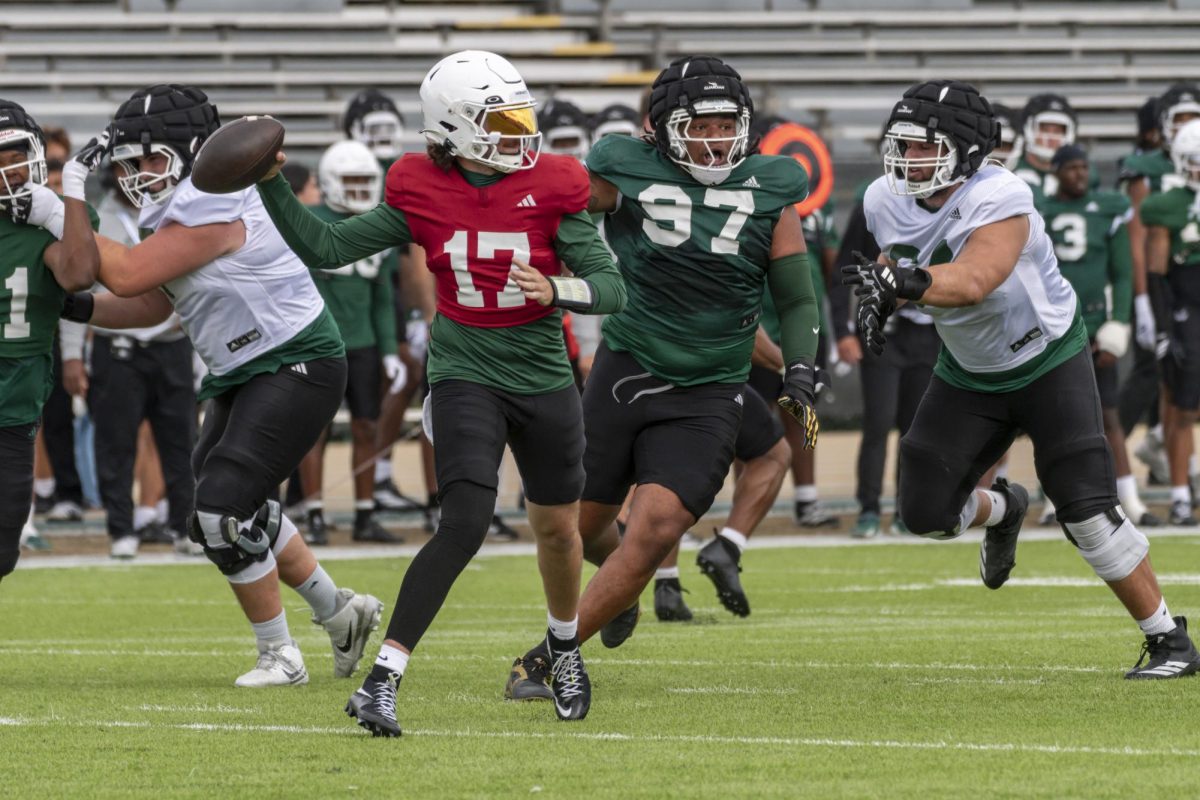
In the offseason, redshirt sophomore quarterback Jaden Rashada was lauded as the answer at the position. With stints at Arizona State and Georgia in his rearview mirror, many expected the former four-star prospect to excel at the FCS level. Two games into the season, it was clear that he couldn’t.
Rashada has a big arm, that much is clear, but he struggled to navigate a crowded pocket and was highly inaccurate with his passes. After a hit to the head sidelined him against Nevada, the play-calling job was given to junior quarterback Cardell Williams, who started for the rest of the season.
While Williams is a talented runner and gave the Go-Go offense a dynamic weapon on the ground, he doesn’t have the arm to break down a defense through the air.
When allowed a clean pocket and an opportunity to put air under the ball for a downfield shot to redshirt freshman wide receiver Ernest Campbell, Williams could make the play, but beyond that, he struggled mightily.
While it seems counterintuitive, throwing deep balls requires less arm strength than making accurate intermediate throws or cross-field throws to the flat. These were balls that Williams couldn’t deliver and ended drives for the Hornets when they got to third and long.
His limited passing profile was highlighted in the season finale against UC Davis. Sac State ran the ball effectively, racking up over 300 yards, but the Aggies began cluing in on the run game late.
Williams only managed 19 passing yards in the contest, completing just three of his nine attempts.
Never before has a statistic been more indicative of a coach’s trust in his man under center; down four with only a few minutes to play, Marion dialed up 14 consecutive running plays.
On the final play of the season’s final drive, Williams needed to make a throw on fourth and 8. It fell multiple yards short of his receiver, who watched on as the season ended.
The Go-Go offense works, but without a complementary quarterback that can punish a defense for selling out to stop the run, it will not result in wins at the highest level.
As UC Davis head coach Tim Plough said, “It’s one-dimensional.”
Where does Sac State go from here?
Evaluating the success of this year’s team comes down to whether this season’s success, a four-win increase from 3-9 to 7-5, is built upon in the coming years.
If Marion and the university can build from this season, recruiting players to fit his smash-mouth identity to create a sustainable “brand” of football for the school, then this season is a win.
If this brand of football is transient, and their head coach and nation’s largest transfer class moves on, Sac State will be left holding the bag – without a conference or a path forward.