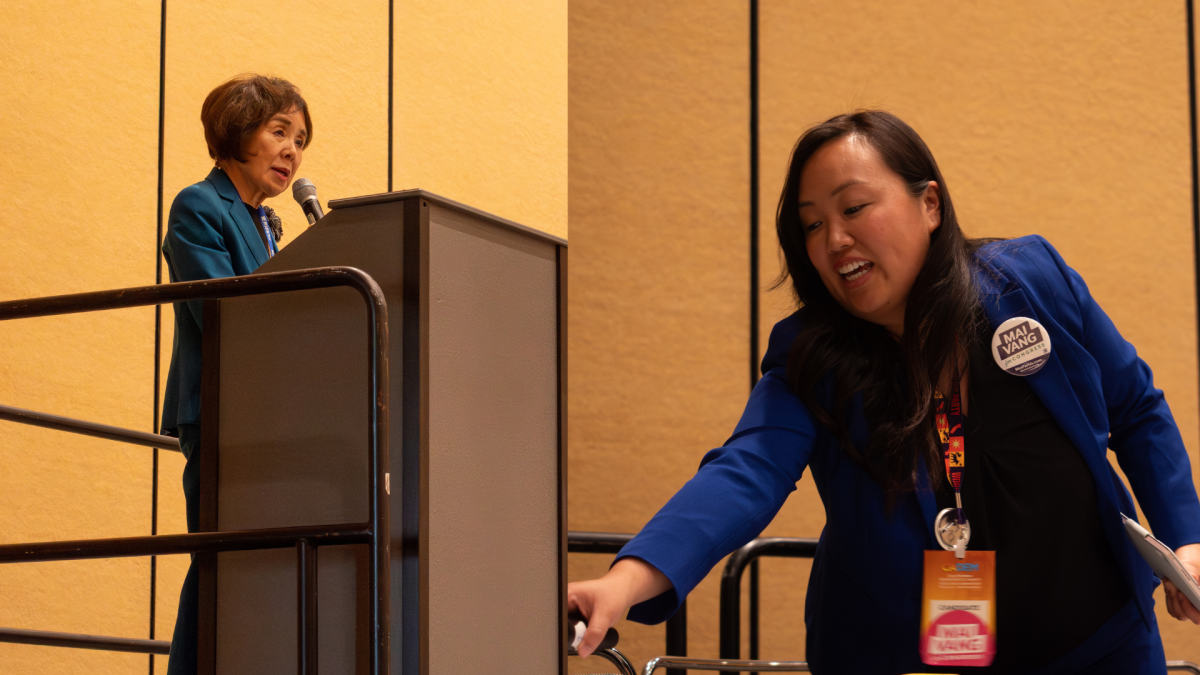

The conference panel “Third World Women Unite!” was held in the University Union by the Asian American Studies program on Tuesday and focused on the quality of life for women in developing countries.
Among the speakers included feminist writer and educator Athia Choudhury, who is currently an assistant professor in Asian American studies at UC Davis. Choudhury studies how violence intersects with gender, with the intersection of health and wellness functions within those areas. She said that her studies aim to make the world accessible for people of all bodies and how that is a form of fighting against colonial ideas.
“I think part of the work that we have to do when we’re thinking about racial and gender equality is also thinking about the body in a very visceral way, in a very real way,” Choudhury said. “Because all of us are going to get sick, our bodies are going to change.”
She said that many women and disabled people have problems accessing the care they need, describing the experience as soul crushing. Choudhury said these difficulties are purposeful and push the idea of society trying to mold and exclude select people from the systems they live under.
“This is a eugenics project that is based on imagining how we build the population and whose bodies we actually think are not worth saving or preserving,” Choudhury said. “When we think about disability justice, it’s gender justice, it’s racial justice. It’s really about imagining if we were to build a different and better world.”
Choudhury reminded the audience that a moment is driven both by rage and kindness. She explained that using one’s rage for productive pushback against these systems is preferred. However, that rage should be motivated by the kindness to lift up and help the communities that are hurting.
Alongside Chouldhury, April Bautista and Pilar Castillo, both of whom are native Filipino-Americans born in the United States, spoke at the panel as representatives of GABRIELA USA, a women’s organization that helps oppressed members of the Filipino community. Bautista was also present as a representative and organizer for the International Women’s Alliance for this panel.
Castillo, GABRIELA USA’s national chairperson, explained that the main goal of the organization is to represent struggling community members living overseas who might not be receiving the help they need. However, she said part of the battle is realizing that violence against women goes beyond generalized ideas like domestic violence.
“The larger aspect of violence against women is actually perpetuated by the state,” Castillo said.
Castillo specifically discussed how it concerns female workers in the Philippines and why they might feel they have to work in those conditions.
“Ten percent of the Philippine population is overseas and half of those people are women,” Castillo said. “What brings us overseas is the need to provide for our families and seeking out a way to do that.”
Castillo explained that the Philippines has been forced into conditions where some Filipinos can’t support their families staying in their homelands.
“It’s actually forced migration, because there is no job growth,” Castillo said. “The impact that has on Filipino women and to actually put food on the table for their families to actually provide. And we’re seeing this systematically done.”
Alongside this, Bautista, the organization’s Secretary General, added that it is important for women to fight back against injustices in the workplace. She said there is also work to be done to protect those in unsafe conditions.
“It’s usually not just in the home. It’s also in the workplace. It’s in society. It’s by the state, sometimes just straight up fascist violence, police violence,” Bautista said.
Bautista also explained that the layers of oppression go deeper than what is typically recognized in mainstream discussions. She said that women face national oppression, where they are treated unfairly by systems based on where they originally come from, on top of working-class oppression, where people are subjected to harsh conditions because they have no other choice but to work.
“When you compare that to the struggle of a garment factory worker in India or a notebook stitcher in the Philippines or a basket weaver in Kenya, the whip, the violence that these women face is a lot more intense and is a lot more brutal, actually,” Bautista said.
Bautista said that while people today think the culture has solved gender oppression, that is actually far from the truth. Women might have more opportunities but still face pushback in spaces separate from the home, emphasizing the importance of fighting for women who face dangerous working conditions.
When Choudhury asked her students what they wanted in life, she said she was shocked that many of her students said they didn’t want to die with debt connected to their names.
“This [is] wild, that this is the extent of the capacity that we have to dream right now,” Choudhury said. “It takes a really strategic, systemic analysis of all of these interconnected systems of violence to recognize we are in this struggle together. There is no liberation until the most vulnerable among us are free.”
All three speakers asked the audience to keep reading and not to be afraid to learn about everything going on that relates to actions of anti-Asian hate or recent U.S. Immigration and Customs Enforcement action. Systems are only as powerful as the people who don’t fight back to correct them, Bautista said.
“We actually take the time to learn about this and then do something about it. We can actually change things,” Bautista said.