

Editor’s Note: The usage of Hispanic, Latino/a/e/x and Chicano/a/e/x is in accordance with the preference and language of the sources and/or organizations included in this story, in addition to the State Hornet Style Guide.
Students, faculty and community members gathered on Monday evening for a “Freedom Seder” to bring light to Jewish cultural traditions and the modern-day struggles of the Latine community with the U.S. immigration crackdown.
Sacramento State’s new Jewish Alumni Network hosted the event, which expanded on the traditional Passover Seder. It also connected the story of the Exodus to present-day issues such as immigration, marginalization and community solidarity.
RELATED: New Jewish Life and Resource Center opens its doors at Modoc Hall
David Benjamin, the president of the Jewish Alumni Network, said the event was intended to reach beyond one community. He said the goal was to create a space for different groups to come together, learn and support each other.
“The idea of a ‘Freedom Seder’ came up as a way to raise awareness about the struggles of marginalized groups — specifically the immigrant community right now. The story of Exodus is about persecution and liberation, and we see parallels today,” Benjamin said. “Part of being in the Jewish community is standing up for those in need. We wanted our first large event to reflect that.”
A “Freedom Seder” evolved from the traditional retelling of the Israelites’ liberation from Egypt with the incorporation of modern struggles faced by different communities. The concept was born after the assassination of Martin Luther King Jr., when Jewish and Black activists came together to connect the Passover story to the Civil Rights Movement and broader fights for justice.
Benjamin said the concept of a “Freedom Seder” helped connect historical narratives to present-day struggles. He said the event focused specifically on raising awareness about marginalized communities.
“We’re allowed to host one large event each year at the Alumni Center,” Benjamin said. “We wanted it to be meaningful, not just for the Jewish community, but for the Sacramento community as a whole.”
Rabbi Nancy Wechsler led guests with a Haggadah, a 15-step text that guides the evening with prayers, songs and instructions on the order of the dinner. The Haggadah for the event was an alternative text created by Wechsler to incorporate both traditional Jewish and Latine symbolism for the focus of the “Freedom Seder.”
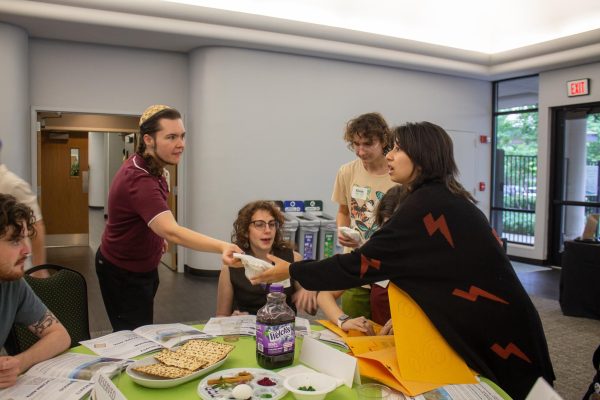
The event was a collaboration between multiple campus and community groups, including the Jewish Faculty and Staff Association and the Chicanx/Latinx Faculty and Staff Association. Chicane/Latine campus scholars and leaders were invited as guest speakers. They shared poems and information about ongoing struggles with immigration enforcement in the Latine community. The partnership aimed to highlight shared experiences between the Jewish and Latine communities that might not always be discussed together.
Lilia Contreras Ramirez, Sac State’s Hispanic-Serving Institution director, said the event centered on overlapping struggles between Jewish and immigrant communities. She said her role was to shape the event through the incorporation of Latinx perspectives into the program.
“This particular ‘Freedom Seder’ was about the overlap of the Jewish community experience, and now what a lot of our immigrant community is experiencing,” Contreras Ramirez said.
Contreras Ramirez said many students on campus come from immigrant backgrounds and that it is important to center those voices in campus events. She said representation and cross-cultural understanding are key parts of building community.
“Because a lot of the students that we serve on this campus, immigrants, … children of immigrants, it is really important to voice that,” Contreras Ramirez said.
Pam Herman, a founding member of the Jerusalem Network and Sac State alumnus, said the goal of the event was to create understanding through storytelling. She said sharing traditions more broadly can help connect communities.
“We wanted to share our story and show how meaningful it is in today’s world. Many people — Jews and others — are facing struggles related to immigration, freedom, antisemitism and other issues we constantly see in the news,” Herman said.
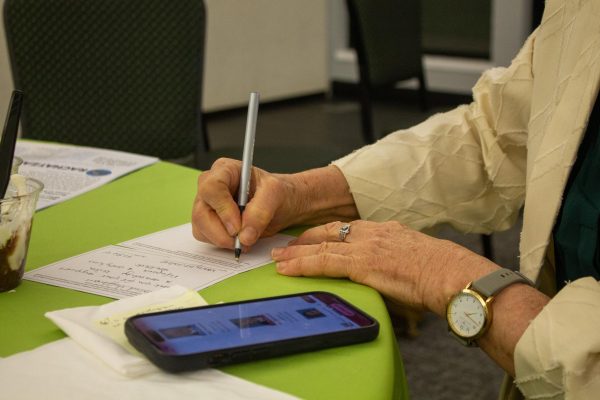
Herman said the Passover story is traditionally shared within the Jewish community, but this event expanded the audience. Herman and other organizers wanted to host a diverse group of attendees. She said outreach and inclusivity were key parts of the planning process.
“It was important to us to have a diverse group — not just Jewish students or faculty. We wanted the broader community involved and to tell the story in a contemporary way,” Herman said.
Heidi Sarabia, an associate sociology professor, said the event reflected a broader effort to build connections across communities. She said collaboration is especially important during times of uncertainty.
“This year is a collaboration between the Chicanx/Latinx Faculty and Staff Association, Jewish faculty, and community groups,” Sarabia said. “The goal is to build bridges across communities.”
Sarabia said events like the “Freedom Seder” help communities come together and support one another through building connections to address shared challenges.
“We’re living in difficult times where rights and freedoms feel threatened,” Sarabia said. “Building connections is what will sustain us and allow us to fight together for dignity and belonging.”